Production · Level 3
Read the artifact ↗ Optional parallel track
Tool recommendation systems
Build a recommender that combines semantic similarity, graph structure, lexical evidence, intent, and telemetry, then test the design in production Snowflake.
Read the pair in order
This track sits alongside the 108-week spine rather than adding another phase. Read the theory first; the production artifact assumes its equations and makes their operational seams visible.
1 · Level 2 · theory
~ KB · numbered sections · ~2 hr full read
2 · Level 3 · production
~ KB · numbered sections · ~3 hr full read
Production · Level 3
Read the artifact ↗ The production seam
Where recommendation math becomes a platform
The same score needs graph-cycle guards, heterogeneous-score normalization, dynamic thresholds, incremental refresh, and a serving path that does not consume the warehouse budget. That is why the production reading is mandatory after the theory, not an interchangeable implementation note.
AI_EMBED + VECTORrecursive CTE + cycle guardweighted Adamic–AdarPERCENTILE_CONTStreams + TasksCortex Search
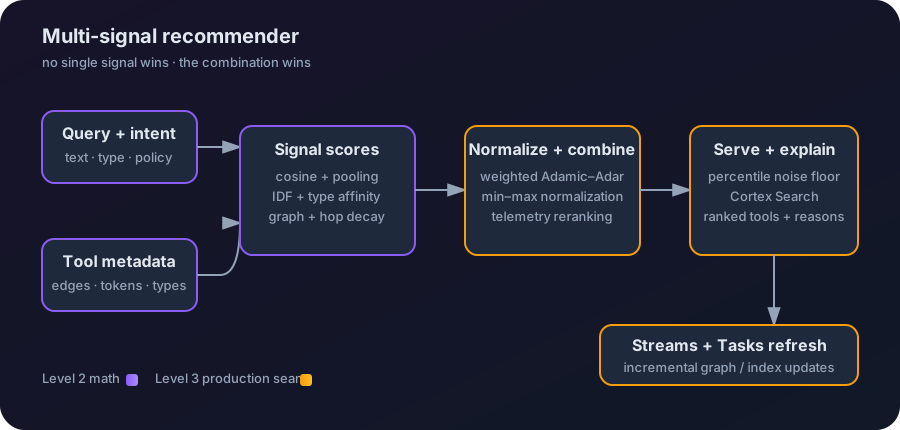
Cross-reference map
Each primitive below is already load-bearing elsewhere. The recommender track makes the combination explicit.
| Spine / capstone | Load-bearing primitive | Why it connects |
|---|---|---|
| W31 | cosine similarity + length-weighted pooling | retrieval math |
| W36 | IDF-weighted token scoring | chunk and lexical scoring |
| W39 | Recall@K, MRR, NDCG evaluation | ranking metrics |
| W77 | graph traversal + hop decay | retrieval patterns |
| W78 | dynamic noise-floor filtering | retrieval evaluation |
| W81 | Adamic-Adar for tool graph | agent foundations |
| W86 | operational telemetry into ranking | monitoring |
| W94 | multi-signal router | traffic routing |
| W97 | type affinity for tenant policies | quotas and priority |
| Capstone 3 | OpenRouter gateway as multi-signal recommender | capstone integration |
Optional depth, strict order
SEARCH.md can stand alone as general recommendation math. SNOWFLAKE.md is deliberately marked as a prerequisite-of-SEARCH pair member: do not start with its SQL. Log one checkbox per section in the learner scaffold and record the production failure you would monitor for each signal.
Return to the 108-week spine →