756 days, sixteen identity shifts
A mandala is a 48-day cycle that ends with a capability you can prove. The 108-week course is 15 full mandalas plus a final 36-day graduation mandala - and every one of them changes who you are as an engineer.
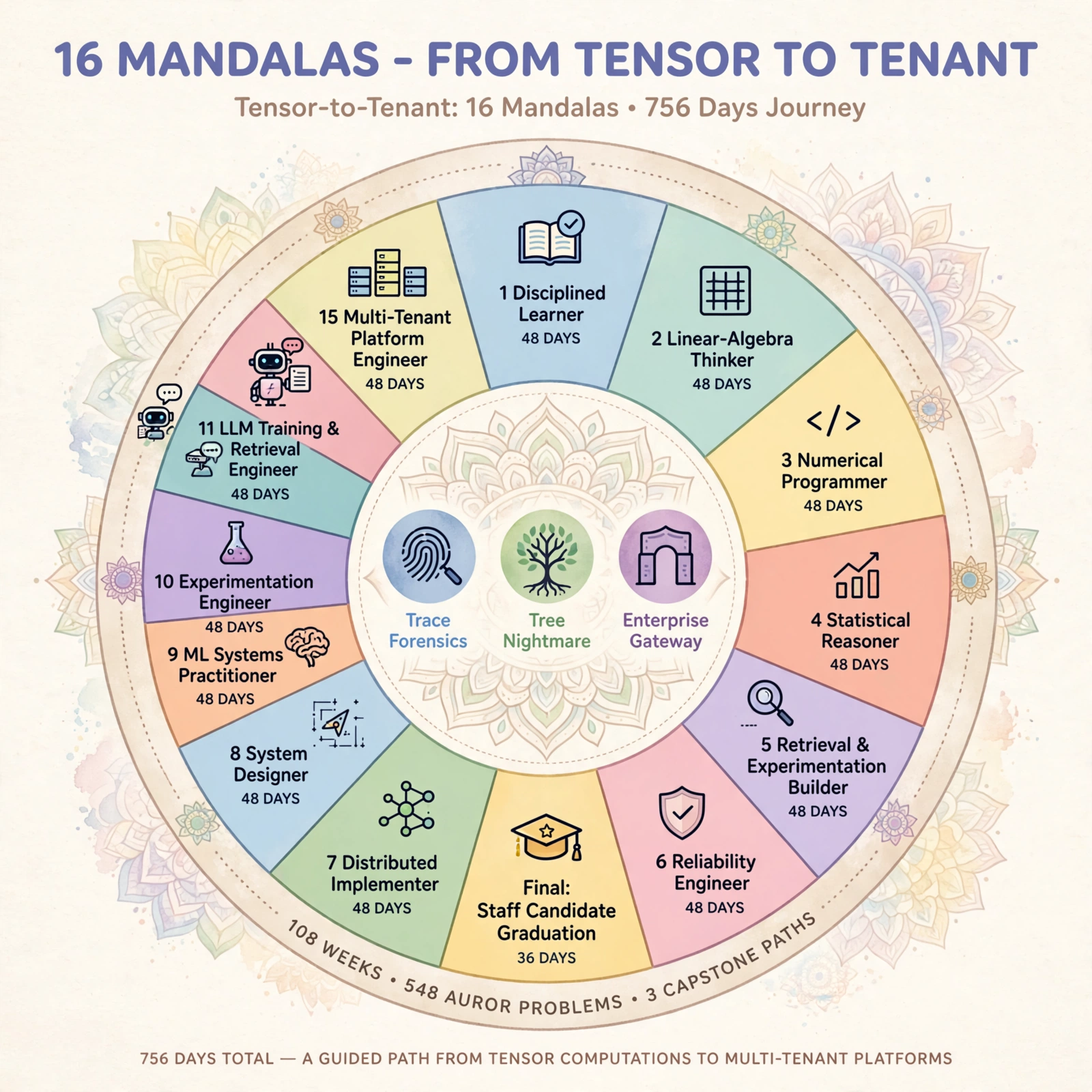
| # | Mandala | Weeks | Identity gained |
|---|---|---|---|
| 1 | Build a reliable learning system | Weeks 1–7 | Disciplined learner |
| 2 | Learn the geometry beneath intelligence | Weeks 7–14 | Linear-algebra thinker |
| 3 | Numerical computation and differentiation | Weeks 14–21 | Numerical programmer |
| 4 | Probability, autodiff and statistical inference | Weeks 21–28 | Statistical reasoner |
| 5 | Experimentation meets retrieval | Weeks 28–35 | Retrieval and experimentation builder |
| 6 | Production reliability and measurable AI | Weeks 35–42 | Reliability-minded engineer |
| 7 | Distributed primitives and design reasoning | Weeks 42–48 | Distributed-systems implementer |
| 8 | Classic distributed systems | Weeks 49–55 | System designer |
| 9 | From system design to ML product science | Weeks 55–62 | ML systems practitioner |
| 10 | Build a mature experimentation platform | Weeks 62–69 | Experimentation engineer |
| 11 | Train, align and retrieve with LLMs | Weeks 69–76 | LLM training and retrieval engineer |
| 12 | RAG, agents and inference foundations | Weeks 76–83 | RAG and agent engineer |
| 13 | Become an inference systems engineer | Weeks 83–90 | Inference performance engineer |
| 14 | Advanced serving and reliable routing | Weeks 90–96 | Serving and routing engineer |
| 15 | Build the enterprise AI platform | Weeks 97–103 | Multi-tenant AI platform engineer |
| 16 | Graduation - portfolio, capstone and interview readiness | Weeks 103–108 | Portfolio-backed Staff AI Systems candidate |
Build a reliable learning system
Disciplined learner
They replace vague plans to study AI with a working weekly process.
- Python engineering, typing, testing and async fundamentals
- NumPy, vectorization and broadcasting
- Git, notebooks, Makefiles and reproducible experiments
- Docker, HTTP, APIs and Linux basics
- Personal mathematics and systems diagnostics
- Weekly journals, evidence tracking and retrospectives
- Vector spaces, span, basis and dimension
- course dashboard and repository
- tested CLI project
- numerical utility library
- reproducible notebook
- diagnostic gap map
- containerized service
- first mathematics problem set
Learn the geometry beneath intelligence
Linear-algebra thinker
Embeddings, attention and matrix models become geometric objects. The learner can reason about them.
- Linear independence, rank and nullity
- Inner products and dual norms
- Orthogonality and projections, Gram–Schmidt
- Coordinate transformations
- Eigenvalues and diagonalization
- PSD matrices and quadratic forms, Rayleigh quotients
- SVD, pseudoinverse and low-rank approximation
- projection and coordinate-transformation labs
- PCA-style experiment
- quadratic-form visualization
- low-rank compression demo
Numerical computation and differentiation
Numerical programmer
They learn to ask whether an algorithm is mathematically correct and numerically sane.
- Matrix norms and conditioning, perturbation analysis
- LU, QR and Cholesky
- Iterative solvers, power iteration and Krylov methods
- Randomized SVD, tensor notation
- Partial and directional derivatives
- Gradients, Jacobians and Hessians, Taylor approximations
- Chain rule on computational graphs
- numerical decomposition library
- solver benchmarks
- perturbation experiment
- randomized approximation lab
- gradient and curvature visualizers
- manual backpropagation worksheet
Probability, autodiff and statistical inference
Statistical reasoner
They can explain why training and evaluation procedures work instead of treating them as imports.
- Computational graphs, forward/reverse-mode autodiff, JVPs and VJPs
- Probability spaces, conditional probability and Bayes
- Random variables and distributions
- Covariance and correlation
- LLN, CLT and delta method
- MLE and MAP, estimator bias and variance
- Hypothesis testing, Type I and Type II errors
- tiny autodiff engine
- probability simulations
- covariance analysis
- Monte Carlo convergence demo
- estimator comparison
- statistical-test implementation
Experimentation meets retrieval
Retrieval and experimentation builder
They can now build the primitives behind search, experimentation and traffic control.
- p-values, confidence intervals, bootstrap and permutation tests
- power, MDE and sample-size calculations, multiple-testing correction
- cosine similarity, exact and memory-bounded KNN
- streaming Top-K and dynamically changing scores
- two-stage retrieval and reranking
- sliding-window and token-bucket rate limiting
- LRU and TTL caching
- bootstrap CI package
- experiment-size calculator
- vector-search mini-lab
- Top-K service
- reranking prototype
- rate-limiter module
- cache simulator
Production reliability and measurable AI
Reliability-minded engineer
They stop thinking only about model output and start thinking about trust, failure, observability and operational behavior.
- text and sentence-aware chunking
- PII span merging, regex and NER-based redaction
- Expected Calibration Error, Brier score and reliability diagrams
- NDCG, MRR and Recall@K
- thread-safe inference batching
- retries, exponential backoff and jitter, circuit breakers
- Count-Min Sketch and Bloom filters
- chunking library
- safe redaction utility
- calibration dashboard
- retrieval evaluator
- concurrent batcher
- fault-tolerance toolkit
- probabilistic data structures
Distributed primitives and design reasoning
Distributed-systems implementer
They can move from implementing one process to reasoning about many machines.
- HyperLogLog, consistent hashing, rendezvous hashing
- weighted load balancing, distributed unique IDs
- leaky-bucket and sliding-window counters
- requirements and constraint gathering, APIs and data modelling
- observability, rate limiting at distributed scale
- cardinality estimator
- routing lab
- load-balancer module
- platform-primitives library
- system-design document template
- first complete design exercises
Classic distributed systems
System designer
They stop naming technologies and start defending architecture.
- scaling reads and writes, caching and replication, contention
- large blob storage and CDNs
- orchestration versus choreography, workflow-state ownership
- backward-compatible schema evolution
- URL shorteners, Dropbox, Ticketmaster, News Feed, WhatsApp, LeetCode-style judges
- scaling-pattern notes
- blob-storage design
- workflow-state architecture
- schema-migration plan
- multiple end-to-end design documents
From system design to ML product science
ML systems practitioner
A production ML system begins with a decision and a dataset, rather than model training alone.
- Uber and web crawlers, ad-click aggregation, payments
- business-objective formulation, model-versus-non-model decisions
- labeling and weak supervision, data augmentation
- leakage and contamination, experiment tracking and versioning
- baselines, slice-based offline evaluation, confidence intervals
- shadow and canary deployment, bandits
- ML project charter
- data-quality checklist
- leakage audit
- evaluation harness
- rollout plan
Build a mature experimentation platform
Experimentation engineer
They can tell when a metric moved and when the evidence supports changing the product.
- A/B-test significance calculation, absolute and relative lift
- pooled standard errors, confidence intervals
- paired bootstrap model comparison
- Sample-Ratio Mismatch detection, chi-square diagnostics
- feature-flag engines, deterministic sticky assignment
- monitoring and drift detection, production incident analysis
- analyze_ab_test
- bootstrap comparison package
- SRM detector
- feature-flag service
- experiment-assignment service
- monitoring specification
- incident postmortem
Train, align and retrieve with LLMs
LLM training and retrieval engineer
They understand the whole upstream and retrieval lifecycle rather than treating the LLM as a remote magic endpoint.
- transformer and tokenizer anatomy, training-data cleaning and deduplication
- SFT, LoRA, QLoRA and DoRA
- RLHF, DPO, ORPO and GRPO
- DDP and FSDP, tensor and pipeline parallelism, ZeRO
- HNSW, IVF-PQ and product quantization
- hybrid retrieval, query rewriting, parent–child and multi-vector retrieval
- model-anatomy notes
- dataset card
- fine-tuning plan
- preference-evaluation plan
- distributed-training architecture
- vector-index benchmark
- retrieval lab
RAG, agents and inference foundations
RAG and agent engineer
They can build an agent and explain where its latency, errors, context and cost come from.
- BM25 + dense + reranker fusion, Reciprocal Rank Fusion
- evaluation by query slice
- prompt templates and version registries
- conversation and long-term memory, context-window optimization
- ReAct, plan-and-execute, tool calling, agent guardrails
- GPU compute-, memory- and overhead-bound regimes, FlashAttention
- roofline models and arithmetic intensity
- retrieval-fusion service
- regression report
- prompt-management tool
- memory service
- agent prototype
- GPU performance primer
- arithmetic-intensity worksheet
Become an inference systems engineer
Inference performance engineer
They can diagnose inference rather than simply complain that it is slow.
- PagedAttention, KV-cache block tables, vLLM deployment
- scheduler and block-manager internals, running/waiting metrics
- latency histograms, Prometheus and Grafana
- request-rate sweeps and saturation analysis
- SGLang, RadixAttention and prefix reuse
- Orca-style continuous batching, chunked prefill
- live vLLM deployment
- internal architecture notes
- metrics schema
- serving dashboard
- benchmark methodology
- vLLM/SGLang comparison
- scheduling report
Advanced serving and reliable routing
Serving and routing engineer
They can optimize a model and a multi-provider inference service.
- continuous batching trade-offs, FP8, AWQ and GPTQ
- KV-cache compression, speculative decoding, Medusa and EAGLE
- StreamingLLM and KV eviction
- DistServe, Splitwise and Mooncake, prefill/decode disaggregation
- model routing, canary assignment and kill switches
- PII-safe traces and logs, async fan-out, partial failures, token-stream multiplexing
- quality-versus-throughput benchmark
- latency and memory lab
- disaggregated serving architecture
- model-router service
- safe tracing layer
- resilient aggregator
Build the enterprise AI platform
Multi-tenant AI platform engineer
This is where “tensor” finally becomes “tenant.”
- distributed token budgets, request prioritization
- DAG workflow execution, idempotency
- per-tenant concurrency limits, leader election
- distributed work queues, dynamic configuration
- model health monitoring, registries and promotion
- semantic and embedding caches, prompt-injection detection
- exact cost attribution, capstone architecture planning
- quota and priority service
- workflow engine
- tenant limiter
- HA lab
- queue/configuration platform
- model-operations pipeline
- cost/safety platform
- complete capstone design document
Graduation - portfolio, capstone and interview readiness
Portfolio-backed Staff AI Systems candidate
They no longer need to tell someone they “know AI systems.” They can provide the repository, traces, benchmarks, design documents and failure tests.
- complete the capstone core API
- build the retrieval or agent flow
- install evaluation, tracing and guardrails
- run load and failure tests, tune latency and cost
- produce architecture and benchmark reports
- complete coding, system-design and behavioral mocks
- publish the portfolio, perform a full retrospective
- create a 30-day career plan
- repository, traces, benchmarks, design documents and failure tests
- published portfolio release
- mock-interview scorecard
- 30-day job-search plan